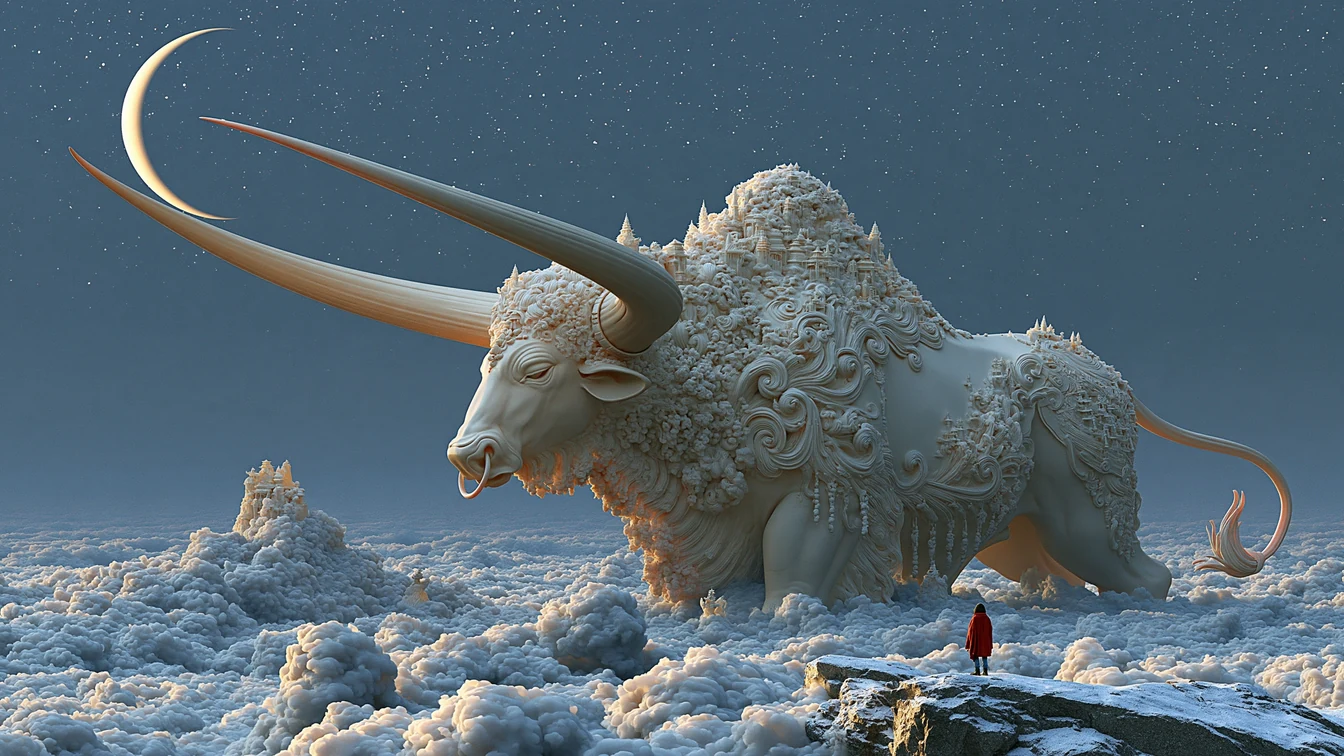
No. 02 · Chinese zodiac Ox · 牛 · Chǒu
The Ox Who Was Already There
Chinese zodiac Ox (牛) — the sign that carried the Rat across the river and came second. The tradition has spent two thousand years insisting that this was not a defeat.
The second hour of the Chinese night, 丑时, falls between one and three in the morning. Nothing happens then. The stars are at their coldest, frost has settled, and the only sound in a farming village is the slow shift of a large animal in a stall, chewing. The Ox owns this hour because the Ox is the creature of the unglamorous interval — the work that happens when no one is watching and no one will remember.
The Specimen
- Earthly branch
- 丑 Chǒu
- Hours
- 01:00 – 03:00
- Element
- Yin Earth
- Direction
- North-northeast
- Season
- Late winter
- Zodiac position
- Second of twelve
Section 01The Coldest Hour
丑时 sits at the far end of the yin phase, only an hour or so before the first grey suggestion of dawn. In the agricultural calendar it was the hour when a farmer might rise to check on a calving, or when the night watch changed. It is not an hour for ambition. It is an hour for maintenance.
That the Ox presides here tells you almost everything the tradition wants you to know about the animal. The Ox is not the zodiac’s hero; it is the zodiac’s infrastructure. Chinese civilisation was built on the water buffalo and the ox — the animals that pulled the plough, turned the terraces, hauled the carts and dredged the canals. A village without an ox did not eat. It is difficult to overstate how much of the culture’s practical life rested on this one creature, and the zodiac remembers it in the least sentimental way possible: by giving the Ox the hour nobody wants.
Section 02Yin Earth
In the five-element scheme the Ox carries yin earth — the receptive, settling expression of the earth phase. Earth is the element of the centre, the pivot the other four turn around, and yin earth is earth at its most patient: the soil rather than the mountain, the field rather than the cliff.
The classic description of an Ox year or an Ox person is reliable to the point of stubbornness. Oxen finish things. They arrive early, they keep their word, and they are constitutionally incapable of the kind of half-commitment that most social life runs on. In a team they are the member whose work is never discussed because it is never in doubt.
The cost is real, and the tradition names it plainly. The Ox does not explain itself. An Ox who has been quietly carrying the whole enterprise for a decade will often be the last person to mention it, and will then be genuinely wounded when nobody noticed. Oxen are also slow to change course — admirable when the direction is right, expensive when it is not. The old proverb warns against arguing with an ox in a furrow: you will lose the argument and the furrow.
Section 03Second Place
The Ox’s story in the great race is short and, on the surface, deflating. It was the Ox that swam the river — steady, powerful, unbothered by the current — while the Rat rode on its head. It was the Ox that reached the far bank first. And it was the Rat that jumped off and crossed the line ahead of it.
Chinese storytelling has never treated this as a tragedy. The Ox is not portrayed as humiliated. It is portrayed as having done the work correctly and having been, in the end, indifferent to the prize. The Rat needed the year; the Ox needed the crossing. The tale is usually told as a wry comment on the difference between people who want credit and people who want the river behind them.
There is a second, quieter reading. The Ox agreed to carry the Rat. It could have refused — a rat on the head of a swimming ox is not, strictly speaking, a burden the Ox had to accept. It said yes, and it kept saying yes all the way across. In a culture that values 德 (dé), moral force accumulated through right action, the Ox’s second place may be the more honourable position in the story.
The Ox needed the year. What it wanted was the river behind it — and it got that.
The Twelve · I Ching
Section 04The Ox in the Fields and in the Temple
The Ox’s cultural footprint is enormous and mostly practical. The 春牛图, the Spring Ox picture, was a calendar illustration printed at the start of each year showing an ox and a herdsman; the colours and proportions encoded the coming weather and harvest, so that farmers who could not read a printed almanac could read a picture of an ox.
The most famous ox in Chinese literature is not a real one. In the Ten Ox-Herding Pictures, a Chan Buddhist sequence of paintings and verses, the ox stands for the mind itself — wild, powerful, hard to find, and finally not something to be caught at all. The herdsman searches for the ox, sees its tracks, catches it, tames it, rides it home, forgets it, and then returns to the marketplace. It is one of the great metaphors of Chinese thought, and it rests on a very specific observation about oxen: that they are not tamed by force. They are tamed by the patient, repeated, entirely unromantic presence of a person who shows up every day.
The Ox also turns up in the language as the measure of effort. 九牛一毛 — “one hair from nine oxen” — is how you describe something so small it does not register against the whole. The Ox is the unit of scale for hard work, which is a strange kind of immortality, and probably the one it would have chosen.

Section 05Reading the Ox
The compatibility tables put the Ox most comfortably with the Rat — the pairing that begins in the race — and with the Snake and the Rooster, the other two members of the zodiac’s second triangle. The difficult pairing is the Goat, whose creative indecision reads to an Ox as simple unreliability.
Underneath the imagery, the Ox is a description of a certain kind of person: the one who is still there in year eleven, when the enthusiasm has gone out of everyone else. The tradition’s advice to the Ox is not to work less. It is to occasionally say out loud what has been carried — because the field does not thank the ox, and never has, and the ox that waits for thanks will wait a long time.
Section 06The Sixty-Year Round
The zodiac is only half a calendar. Twelve animals cycle against ten heavenly stems, and the stems run in pairs through the five elements, so the true cycle is sixty years and each animal appears in it five times — once per element, never in the same form twice.
There is no single Ox. There are five:
Wood Ox (1925, 1985) — the most adaptable of the five and the least rigid; still stubborn, but capable of changing its mind. Fire Ox (1937, 1997) — the most impatient, and the one most likely to be underestimated because patience is what everyone expects. Earth Ox (1949, 2009) — the purest expression of the sign: immovable, reliable, and almost impossible to hurry. Metal Ox (1961, 2021) — the most disciplined and the most successful in institutional life; the Ox that ends up running the thing. Water Ox (1973, 2033) — the most flexible and the most quietly perceptive; a Water Ox will work around an obstacle for a decade rather than argue with it once.
The distinction matters more for the Ox than for most signs, because the Ox’s defining quality — patience — is the one most modified by element. An Earth Ox and a Fire Ox share a sign and almost nothing else.
Section 07The Year of the Ox
An Ox year returns every twelve years, and the tradition reads it as a year of consolidation rather than expansion. Ox years are for finishing, for repair, for the unglamorous work that makes the next cycle possible. They are not considered lucky years for sudden moves. They are considered good years for the things that only get done when nobody is watching.
For someone born in an Ox year, 本命年 — the return of one’s own zodiac year, at twelve, twenty-four, thirty-six and so on — is the year the cycle comes back to its own beginning. The tradition treats it as a year of movement under the year god 太岁, and the standard protection is red: a red belt or red underclothes, given by an elder, worn from before the new year.
The custom carries an unusually specific meaning for an Ox. The Ox does not ask for help; that is the whole shape of the sign. A 本命年 forces the issue, because the belt is not something you buy for yourself. Somebody else has to give it to you. For one year in every twelve, the Ox is obliged to accept something it did not earn and cannot repay — which, if you read the race story again, is roughly what the Rat asked of the Ox at the river.
The advice the tradition gives an Ox in its own year is therefore the same advice it gives all year, only louder. Say the thing out loud. The field does not thank the ox. It never has.