No. 03 · Chinese zodiac Tiger · 虎 · Yín
The Hour the Tiger Walks
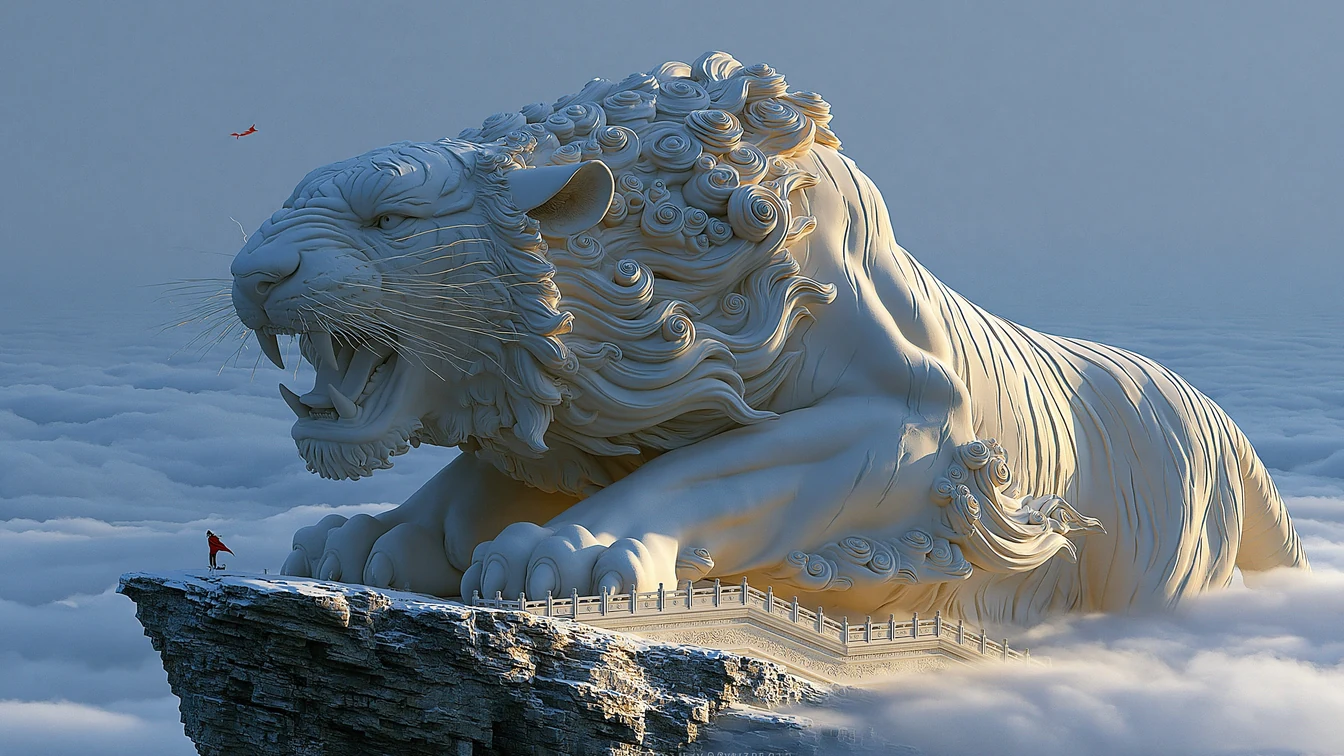
Chinese zodiac Tiger (虎) — between three and five in the morning the mist is thickest and the forest is loudest. The Tiger does not hide in that hour. It uses it.
寅时 is the hour of the pre-dawn dark, when the night has not yet given up and the day has not yet committed. Mist sits low in the valleys. Sound carries strangely. In the old bestiaries this was the hour when the tiger hunted — not because it was hungry, but because this was when its advantage was greatest. The animal that gives its name to 寅 is the one that chooses the moment when everything else is uncertain.
The Specimen
- Earthly branch
- 寅 Yín
- Hours
- 03:00 – 05:00
- Element
- Yang Wood
- Direction
- East-northeast
- Season
- Early spring
- Zodiac position
- Third of twelve
Section 01The Third Hour
寅时 runs from three to five in the morning. It is the hinge of the night: the last of the yin hours, and the first in which the world begins, very faintly, to turn. In the classical scheme the tiger is a yang animal presiding over the last dark hour before yang returns — a predator standing at the boundary, which is exactly where tigers have always lived in the Chinese imagination.
The tiger is the only animal in the twelve that the tradition treats with outright fear. The dragon is revered, the ox is relied upon, the rat is tolerated. The tiger is the one that people were genuinely afraid of, and the zodiac keeps that fear intact rather than softening it. In the old hierarchies of the living world, 虎 was the king of the beasts — not the lion, which is not native to China and appears mostly as a decorative import, but the tiger of the northern forests and the southern hills.
Section 02Yang Wood
In the five-element system the Tiger carries yang wood: growth in its most forceful form. Wood is the spring phase, the element of expansion and upward pressure — a seed cracking stone, bamboo pushing through soil. Yang wood is that force with a direction and a temper.
Tiger people are consistently described in the same terms across the tables: brave, direct, magnetic, impatient. They tend to be the ones who move first in a room and apologise later, if at all. They are unusually good in a genuine crisis and unusually bad in a tedious one. The Tiger’s authority is not granted by position; it is the kind that arrives in a person before anyone has decided to give it to them.
The weaknesses are the mirror of the strengths, and the tradition does not flinch from them. Tigers are impulsive. They take risks that are not calculated but merely felt. They are capable of a sudden, total reversal — the tiger that has been perfectly calm for months can turn on an ally over a small humiliation. And because the Tiger is used to being deferred to, it rarely learns to argue. The old caution is that a tiger who has never been contradicted eventually mistakes its own temper for the truth.
Section 03The Third to Cross
In the race, the Tiger came third. The versions differ on the details, but the common thread is that the Tiger did not swim. It came down out of the mountains, crossed where the current was manageable, and arrived with the authority of an animal that had never seriously considered losing.
There is a nice piece of characterisation buried in the placement. The Rat won by trickery, the Ox came second by endurance, and the Tiger came third by simply being formidable. Three consecutive places, three completely different theories of how to succeed — which is, more or less, the whole point of having twelve animals rather than one.
If you do not enter the tiger’s den, how will you get the cub? The tradition has never once suggested you should stay outside.
The Twelve · I Ching
Section 04The Tiger on the Wall and at the Door
The tiger’s most important role in Chinese domestic life was apotropaic. Pictures of tigers were hung in houses to drive off evil; tiger charms were given to children; tiger-head shoes and tiger-head hats were standard dress for toddlers in much of northern China, on the theory that a small person wearing a predator’s face would be left alone by worse things. The character 虎 appears on door gods and on the walls of temples, usually paired with the dragon.
The pairing is one of the oldest in Chinese cosmology: 左青龙,右白虎 — the Azure Dragon of the east on the left, the White Tiger of the west on the right. In that scheme the tiger is not simply a beast but a direction, a season, a colour, and a phase of the year. The White Tiger governs autumn and the west, the season of metal and of harvesting, the time when things are cut down. It is a colder, more administrative tiger than the folk tiger of the nursery — the same animal seen from the throne rather than from the village.
The language keeps the tiger close as well. 虎口 — “the tiger’s mouth” — is how you describe being in mortal danger. 生龙活虎, “a live dragon and a living tiger”, is how you describe someone with enormous energy. And the best of them, 不入虎穴,焉得虎子 — “if you do not enter the tiger’s den, how will you get the cub?” — is the tradition’s whole position on risk in eight characters.
Section 05Reading the Tiger
The compatibility tables place the Tiger with the Horse and the Dog — the zodiac’s third triangle, three animals that all run. The difficult pairing is the Monkey, whose instinct to play and outwit is precisely the thing a Tiger cannot tolerate being on the receiving end of.
The tradition’s advice to the Tiger is not to become gentler. It is to notice that the hour it owns is only two hours long. The mist lifts. The advantage closes. A tiger that hunts well past 寅时 is no longer a hunter; it is just an animal in the open, and everyone can see it.
Section 06The Sixty-Year Round
Twelve animals run against ten heavenly stems, and the stems cycle in pairs through the five elements. The result is a sixty-year round in which every animal appears five times, once under each element. The Tiger’s five forms are unusually different from one another:
Fire Tiger (1926, 1986) — the most explosive and the most charismatic; the one that burns brightest and cools fastest. Earth Tiger (1938, 1998) — the most stable and the most strategic; a Tiger that thinks before it moves, which makes it considerably more dangerous. Metal Tiger (1950, 2010) — the most disciplined and the most ambitious; this is the Tiger that builds an institution rather than walking away from one. Water Tiger (1962, 2022) — the most perceptive and the most private; a Tiger whose authority comes from understanding rather than from volume. Wood Tiger (1974, 2034) — the most generous and the most restless; the classic adventurer of the five.
Two Tigers born twelve years apart can be almost unrecognisable to each other. The animal supplies the appetite; the element supplies everything about how it is pursued.
Section 07The Year of the Tiger
A Tiger year comes every twelve years and is read, unsurprisingly, as a year of large movement. The tradition associates it with boldness, disruption, and a general rise in the temperature of public life. Tiger years are considered excellent for beginnings and poor for quiet consolidation — the opposite of the Ox year that precedes them.
For anyone born in a Tiger year, 本命年 — the return of one’s own sign at twelve, twenty-four, thirty-six — is the year of 太岁, the year god, whose position in the sky you are said to be standing directly under. The conventional protection is red worn from before the new year: a belt, a cord, underclothes, given by an older relative rather than bought for oneself.
The custom is particularly pointed for a Tiger. The Tiger’s whole method is to move first and trust the movement. A 本命年 asks it to accept that in this one year, someone else’s gift is doing work that the Tiger’s own force cannot. It is not a comfortable instruction for the sign, which is probably why the tradition repeats it.
The advice offered to a Tiger in its own year is the same as the advice offered in every other year, only more urgent. The hour it owns is two hours long. The mist lifts. A Tiger that has learned to recognise the end of its own advantage is a considerably more formidable animal than one that has not.