No. 04 · Chinese zodiac Rabbit · 兔 · Mǎo
The Rabbit on the Moon
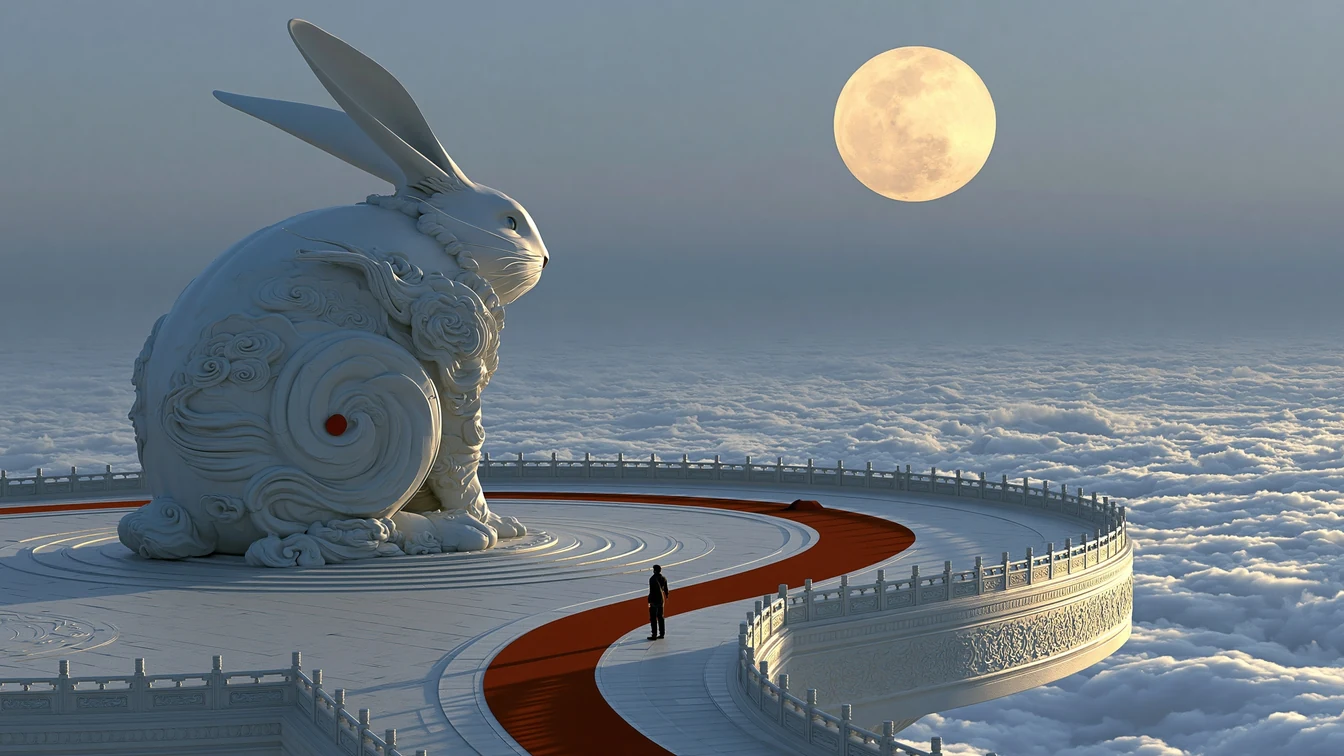
Chinese zodiac Rabbit (兔) — two rabbits live in the tradition: a gentle sign of luck, and a solitary figure who has been pounding medicine on the moon for longer than anyone can remember.
卯时 is the hour of first light — five to seven in the morning, when the sky goes the colour of a peach and the dew is still on everything. It is the softest hour of the Chinese day, the moment when the world is briefly perfect and nobody has done anything wrong yet. The Rabbit owns it, and has owned it for two thousand years.
The Specimen
- Earthly branch
- 卯 Mǎo
- Hours
- 05:00 – 07:00
- Element
- Yin Wood
- Direction
- East
- Season
- Spring
- Zodiac position
- Fourth of twelve
Section 01The Fourth Hour
In the traditional reckoning the twelve animals are not attached to the hours arbitrarily; each pairing is an observation about when the animal is most itself. 卯时 is when hares are said to leave their forms and feed, moving through wet grass in the half-dark before people are awake. It is also the hour when the moon sets and the sun rises at the same time — a double light, which is exactly the kind of liminal detail the tradition likes to encode.
卯 is the fourth of the twelve earthly branches and the second of the three spring months. In the classical scheme it governs the middle of spring, the point at which the season is fully established and beginning, very slowly, to lean toward summer. Everything about the Rabbit’s placement says the same thing: it is the animal of the moment when a thing has just become itself and has not yet been tested.
Section 02Yin Wood
The Rabbit carries yin wood: the soft expression of the growth phase. Where the Tiger is yang wood — a seed cracking stone — the Rabbit is yin wood, the flexible shoot that bends in wind and does not break. Same element, opposite temperament.
Rabbit people are consistently described as refined, diplomatic and aesthetically alert. They are the ones who notice the room is too loud before anyone else does, who remember what you said you liked three months ago, who can defuse a fight by changing the subject so gracefully that nobody realises a fight was happening. In a tradition that has always valued 文 (wén) — the civil, the cultivated, the literary — the Rabbit is the zodiac’s aristocrat.
The tradition is honest about the price. Rabbits avoid conflict so thoroughly that they will accept a bad situation rather than name it. They are prone to melancholy, and to a specific kind of moodiness that arrives without a cause and leaves the same way. And because the Rabbit is so skilled at accommodating other people, it can go a very long time without anyone knowing what it actually wants — including, eventually, the Rabbit.
Section 03Fourth Across
The race story gives the Rabbit a modest, slightly enigmatic fourth place. In the most common version it crossed the river by finding stones and logs and using them as stepping stones, and arrived just behind the Tiger.
What is notable is that the Rabbit is never the villain of the race and never the hero. It simply gets across, without drama, using what was already there. Several tellings add a small detail: the Rabbit paused to help another animal, or to make sure of its footing. It is the kind of characterisation that would be invisible in a story about the Rat, and which is the whole of the Rabbit.
Two figures live on the moon, and both of them are doing unrewarded work. The tradition has always known who does the quiet labour.
The Twelve · I Ching
Section 04The Moon Rabbit
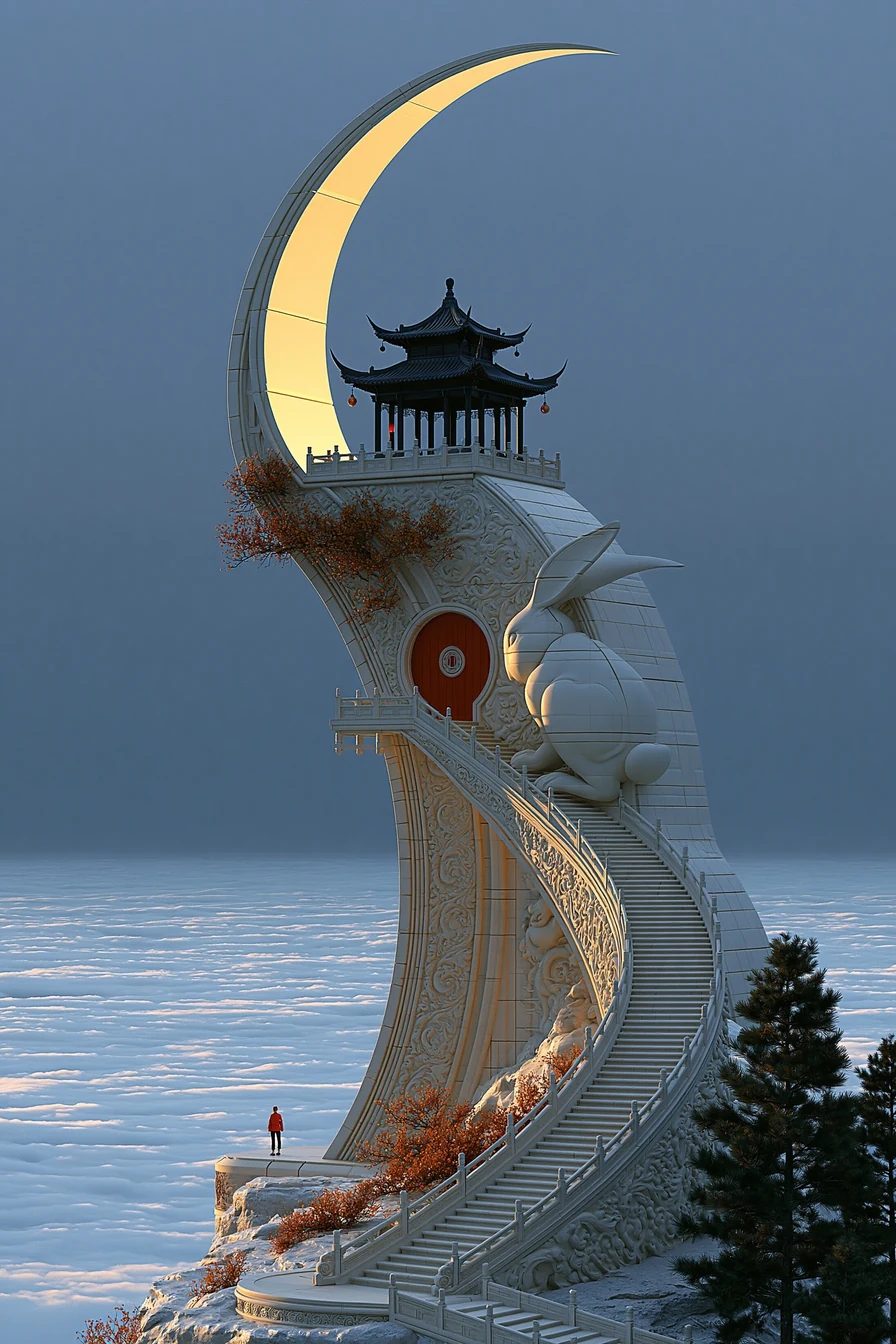
The Rabbit’s most important mythological role is entirely separate from the zodiac. In Chinese tradition the moon is inhabited by a rabbit — 玉兔, the Jade Rabbit — who stands beneath a cassia tree (桂花树) pounding the elixir of immortality in a mortar. The image is extremely old, appearing in Han dynasty tomb art, and it is the Rabbit, not the Man in the Moon, that Chinese children have been shown for two thousand years.
The story has a melancholy undertone that the cute folk-art rabbit tends to conceal. The Jade Rabbit is alone up there. In some tellings it is serving a sentence; in others it is doing an endless, unwitnessed labour for someone else’s benefit. Mid-Autumn Festival, when the moon is fullest, is the night the tradition looks at it most directly — families eat mooncakes shaped like the moon and children are told about the rabbit with the pestle.
There is also the well-known image of the moon rabbit’s companion, the woodcutter Wu Gang, who is condemned to chop at a self-healing cassia tree forever. Two figures on the moon, both doing unrewarded work: it is a surprisingly bleak set of stories to attach to the zodiac’s gentlest sign, and it may be the tradition’s way of saying that the gentle are often the ones doing the work no one sees.
Section 05Reading the Rabbit
The compatibility tables pair the Rabbit most happily with the Goat and the Pig — two other signs that prefer harmony to confrontation — and with the Dog, whose loyalty gives the Rabbit something solid to lean against. The difficult pairing is the Rooster, whose blunt commentary is exactly what a Rabbit cannot absorb.
The tradition’s advice to the Rabbit is the inverse of its advice to the Tiger. Do not go faster. Say the thing. The Rabbit’s entire gift is knowing what everyone in the room needs, and its entire trap is never saying what it needs itself — which is how a person ends up, quietly and without anyone intending it, on the moon with a pestle.
Section 06The Sixty-Year Round
The twelve animals cycle against ten heavenly stems, and the stems move in pairs through the five elements — which is why the real cycle is sixty years, not twelve, and why each animal appears five times in it. The Rabbit’s five forms:
Fire Rabbit (1927, 1987) — the warmest and most socially gifted of the five; a Rabbit with enough force to actually say what it wants. Earth Rabbit (1939, 1999) — the most practical and the most settled; the one most likely to build something durable rather than beautiful. Metal Rabbit (1951, 2011) — the most decisive and the most ambitious; a Rabbit whose gentleness is a policy rather than a temperament. Water Rabbit (1963, 2023) — the most intuitive and the most emotionally porous; the classic artist of the five. Wood Rabbit (1975, 2035) — the most imaginative and the most easily hurt; the softest expression of an already soft sign.
The Rabbit is the sign whose element makes the largest difference to how it presents in the world, because the animal itself is defined by receptivity. A Metal Rabbit and a Wood Rabbit will both avoid a fight. Only one of them will avoid it because it has already decided the fight is not worth winning.
Section 07The Year of the Rabbit
A Rabbit year returns every twelve years. The tradition reads it as a quiet year — a year for diplomacy, for the arts, for repairing relationships, and for anything that benefits from being done gently. It is regarded as a good year to start something that needs to last and a poor year for confrontation.
本命年, for a Rabbit, is the return of its own sign at twelve, twenty-four, thirty-six. The traditional understanding is that the year god 太岁 is passing overhead and that a person born under the same sign is unusually exposed to the year’s movement. The remedy is the same as for every sign: red, worn from before the new year, given by an elder.
There is a specific tenderness to the Rabbit’s version of this custom. The Rabbit is the sign least likely to ask for anything, and the sign most likely to be quietly struggling while appearing perfectly composed. A 本命年 is the one year in twelve when the tradition insists that somebody else hands the Rabbit something — and the Rabbit has to accept it, because refusing a gift from a grandparent is not an option in any culture.
The advice the tradition gives a Rabbit in its own year is the same as in every other year, and it is the hardest instruction in the cycle for this sign to follow. Say the thing. The Rabbit’s gift is knowing what everyone in the room needs. Its trap is never once mentioning what it needs itself.