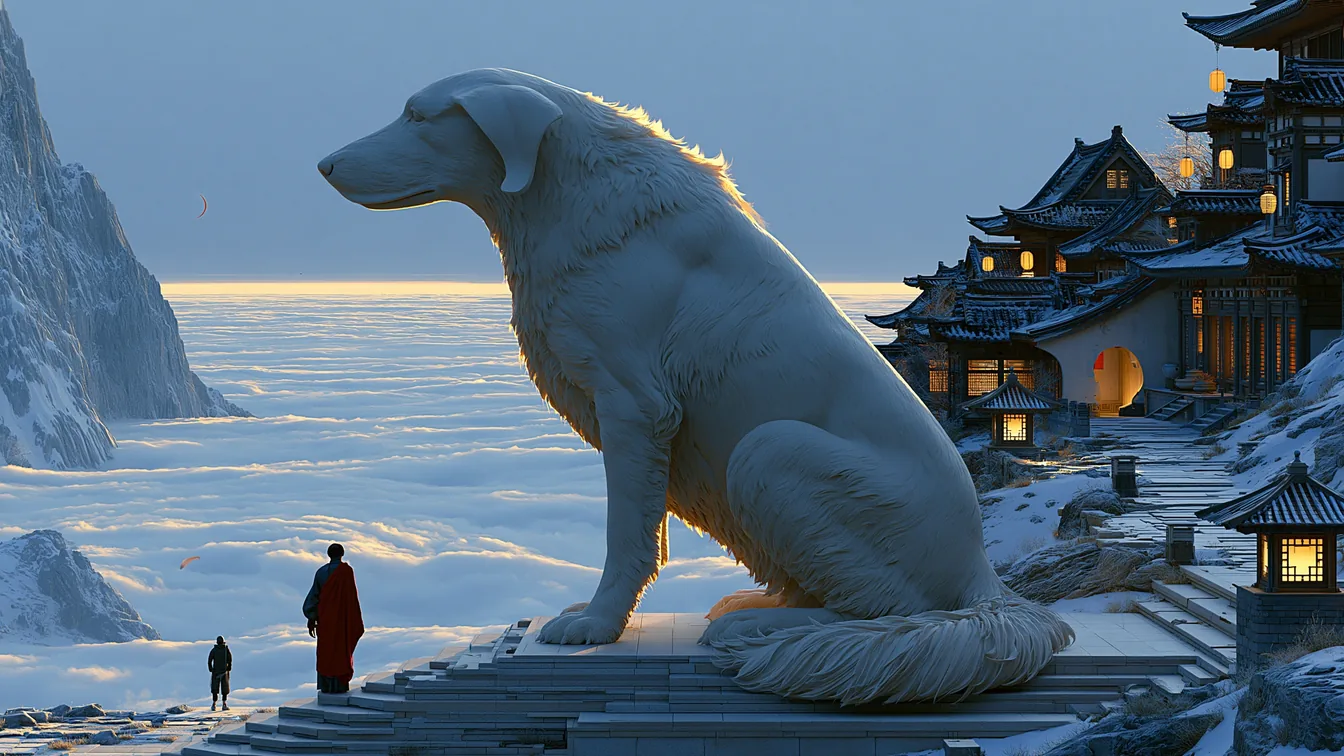
No. 11 · Chinese zodiac Dog · 狗 · Xū
The Dog at the Gate
Chinese zodiac Dog (狗) — the eleventh sign guards the boundary between the house and everything outside it. The tradition has never described the Dog as lucky, only as the reason the door holds.
戌时 falls between seven and nine at night, when the lamps are lit, the gate is closed, and the day’s strangers have become something to be kept outside. In the old towns this was the hour of the night watch, the first round of the dogs, the moment the household turned from the world to itself. The eleventh hour belongs to the animal whose entire job was the boundary.
The Specimen
- Earthly branch
- 戌 Xū
- Hours
- 19:00 – 21:00
- Element
- Yang Earth
- Direction
- West-northwest
- Season
- Late autumn
- Zodiac position
- Eleventh of twelve
Section 01The Eleventh Hour
戌时 is the second hour of the night and the last month of autumn in the classical calendar. The harvest is finished, the fields are bare, and the year is closing down. It is the hour when a village becomes a collection of separate lit rooms, and when the question of who is inside and who is outside stops being theoretical.
The Dog’s placement is the most functional of the twelve. It is not a beautiful sign, a clever sign, or a lucky sign. It is the sign that guards the gate, and every settled human society has needed that more than it has needed any of the others.
Section 02Yang Earth
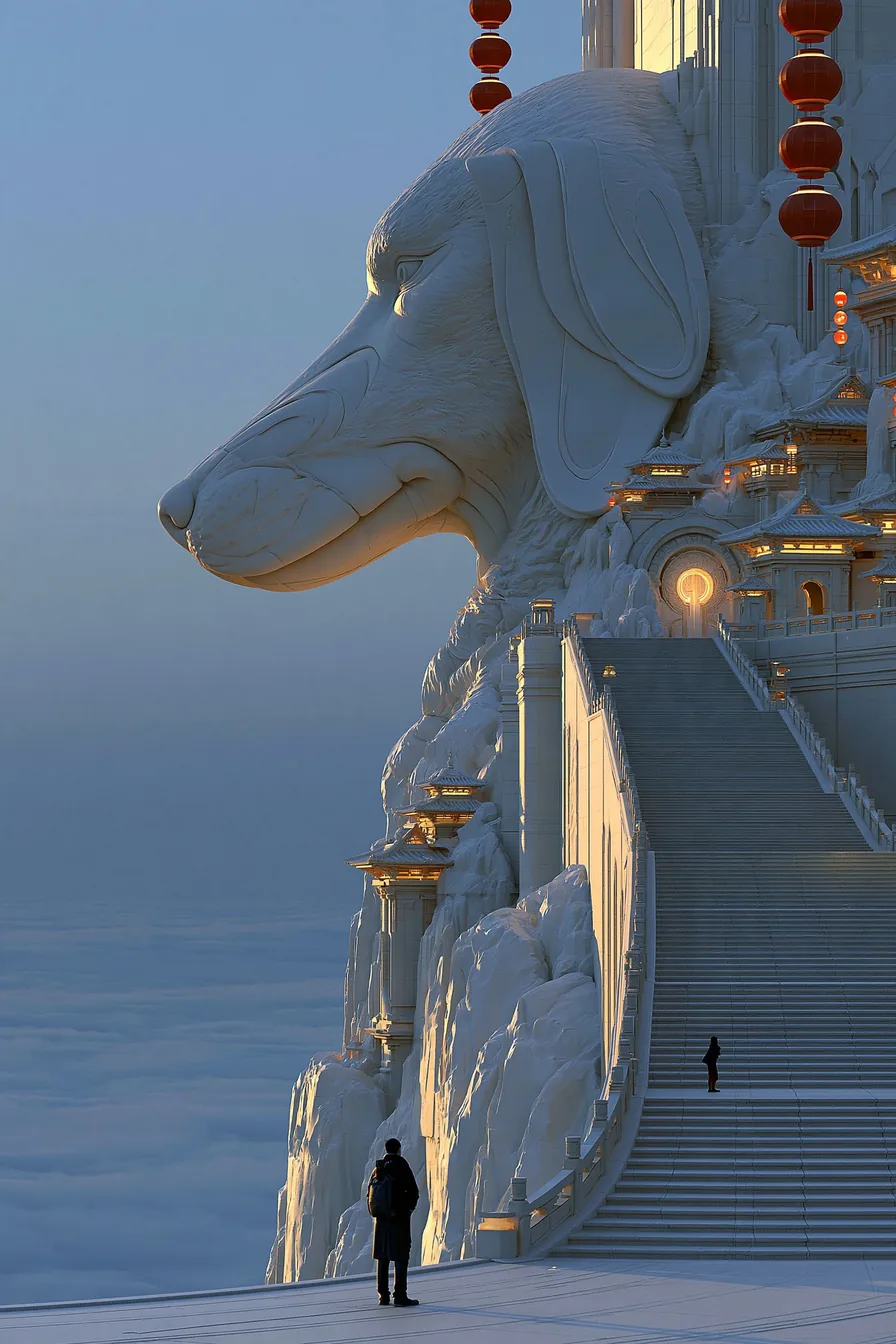
The Dog carries yang earth — the third of the four earth signs in the zodiac, and the one that is oriented outward. Where the Ox is earth as cultivation and the Goat is earth as endurance on poor ground, the Dog is earth as the boundary line: the wall, the threshold, the marked edge of what is mine and what is not.
Dog people are described as loyal, honest, just and dependable. They are the sign most consistently associated with a sense of duty, and with a genuine discomfort at unfairness that other signs simply do not feel as strongly. A Dog will take the smaller share without mentioning it, and will become genuinely distressed if someone else is treated badly in front of them.
The tradition names the weaknesses just as plainly. Dogs worry — a low, constant anxiety about the people they have decided to protect, which can become controlling. They are pessimistic, inclined to expect the worst and to be quietly annoyed when they are told to cheer up. And they are stubborn in a specific way: a Dog that has decided something is wrong cannot be argued out of it by any amount of evidence, because the Dog’s judgment is moral rather than analytical and does not run on evidence.
Section 03Eleventh, Because It Went Swimming
The Dog’s race story is the only one in the twelve that is openly comic. The Dog was fast. It was in a strong position. And on the way across the river it discovered that it was having a wonderful time in the water, and stopped to enjoy itself — and by the time it remembered the race, ten animals had finished.
It is a genuinely funny image, and it is also the most human moment in the whole cycle. Every other animal in the race is either working or scheming. The Dog is the only one that gets distracted by pleasure and loses a place because of it. The tradition tells this story without contempt. The Dog is not the villain of the race and it is not the fool. It is the animal that was briefly happy, and paid for it.
A dog does not despise a poor home. It is the highest compliment the tradition pays to any animal.
The Twelve · I Ching
Section 04The Dog in the World
The dog’s position in Chinese culture is warmer than its reputation in some neighbouring traditions, where dog is a term of abuse. In Chinese folk religion the dog is a guardian: stone dogs and lion-dogs stand at temple gates and at the doors of important buildings, and the 天狗 — Heavenly Dog — is a genuine celestial figure, associated with eclipses and with the protection of children.
The Dog is also the eleventh sign in the zodiac’s fourth-and-final grouping. The traditional triangles are Rat-Dragon-Monkey, Ox-Snake-Rooster and Tiger-Horse-Dog, with Goat-Rabbit-Pig as the fourth. The Dog’s group is the one the tradition describes as the doers: three signs that act first and explain later.
And the Dog carries one of the most quietly moving idioms in the language. 狗不嫌家贫 — “a dog does not despise a poor home.” It is used to describe loyalty that does not depend on circumstances, and it is the highest compliment the tradition pays to any animal.
Section 05Reading the Dog
The compatibility tables pair the Dog with the Tiger and the Horse — the three signs that run — and with the Rabbit. The difficult pairing is the Dragon, whose sense of its own exceptionalism is precisely the thing a Dog’s sense of fairness cannot accommodate.
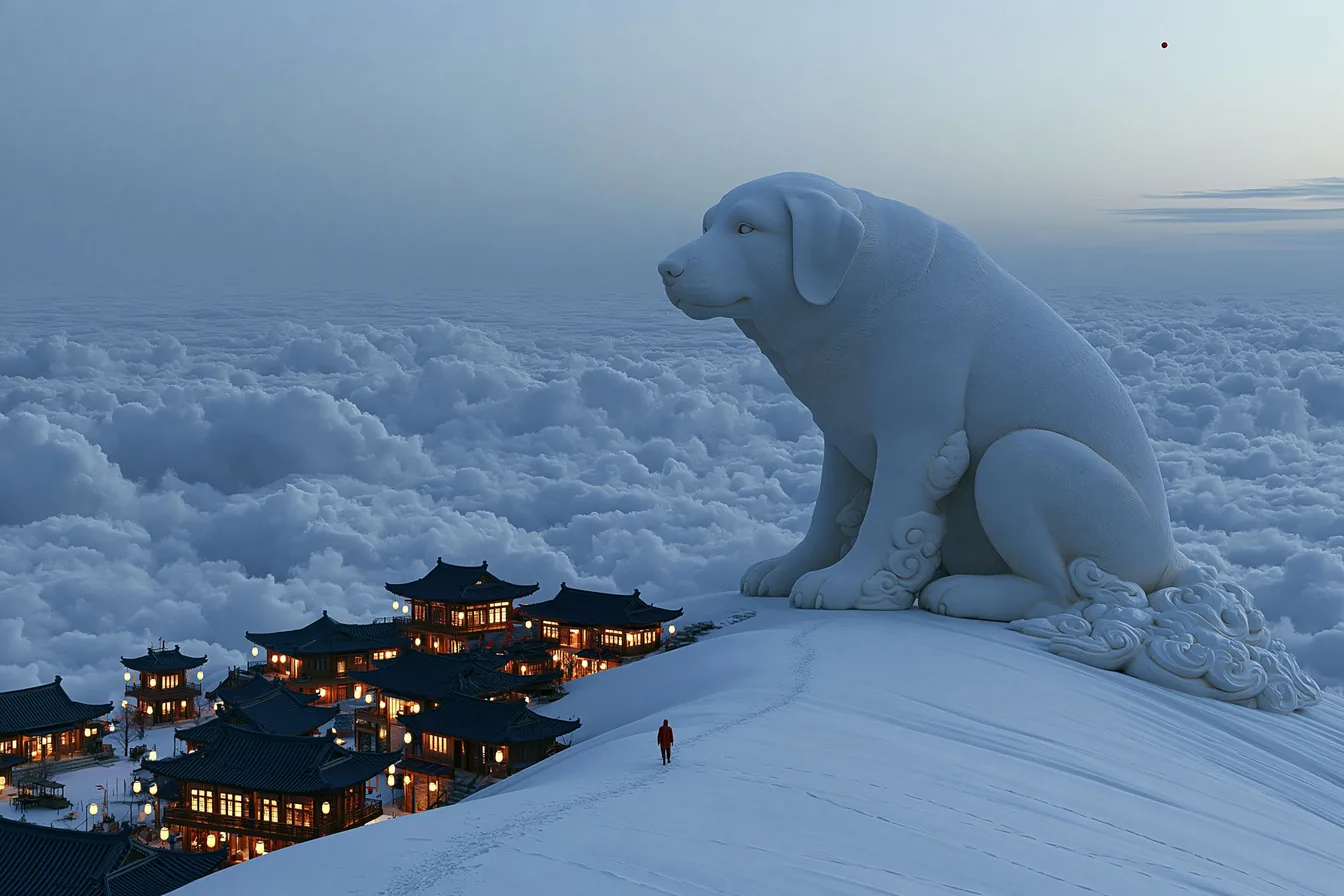
The tradition’s advice to the Dog is the gentlest advice in the cycle, because the Dog is the sign least in need of correction and most in need of rest. The gate is closed. The people inside are safe. The Dog that spends the whole night listening for footsteps has protected nobody — it has simply spent the night.

Section 06The Sixty-Year Round
Twelve animals run against ten heavenly stems, and the stems cycle in pairs through the five elements. The true round is sixty years, with each animal appearing five times. The Dog’s five forms:
Wood Dog (1934, 1994) — the most idealistic and the most generous; the Dog most likely to take a stand on principle and pay for it. Fire Dog (1946, 2006) — the most energetic and the most outspoken; loyalty with a short fuse. Earth Dog (1958, 2018) — the steadiest of the five and the purest expression of the sign: reliable, anxious, immovable. Metal Dog (1970, 2030) — the most disciplined and the most dutiful; the one that carries the most and says the least. Water Dog (1982, 2042) — the most sensitive and the most perceptive; a Dog that knows what you are feeling before you do, and will never mention it.
The Dog is the sign most consistently defined by its relationship to other people, so the element changes not what the Dog feels but how much of it gets expressed. An Earth Dog and a Fire Dog will both take the smaller share. Only one of them will tell you about it.
Section 07The Year of the Dog
A Dog year returns every twelve years. The tradition reads it as a year of consolidation and responsibility — good for settling matters, for repairing institutions, and for the unglamorous work of keeping promises. It is not a year associated with sudden fortune.
本命年, for a Dog, is the return of its own sign at twelve, twenty-four, thirty-six. The year god 太岁 is understood to pass directly overhead, and the conventional protection is red, given by an elder before the new year begins.
The custom lands gently on the Dog, which is the sign most comfortable with obligation. A red belt from a grandparent is, to a Dog, simply another thing to be responsible for — and the Dog will wear it until it falls apart, and will not lose it, and will not need to be reminded.
The advice the tradition gives a Dog in its own year is the gentlest counsel in the cycle, because the Dog is the sign least in need of correction and most in need of rest. The gate is closed. The people inside are safe. A Dog that spends the whole night listening for footsteps has protected nobody. It has simply spent the night.