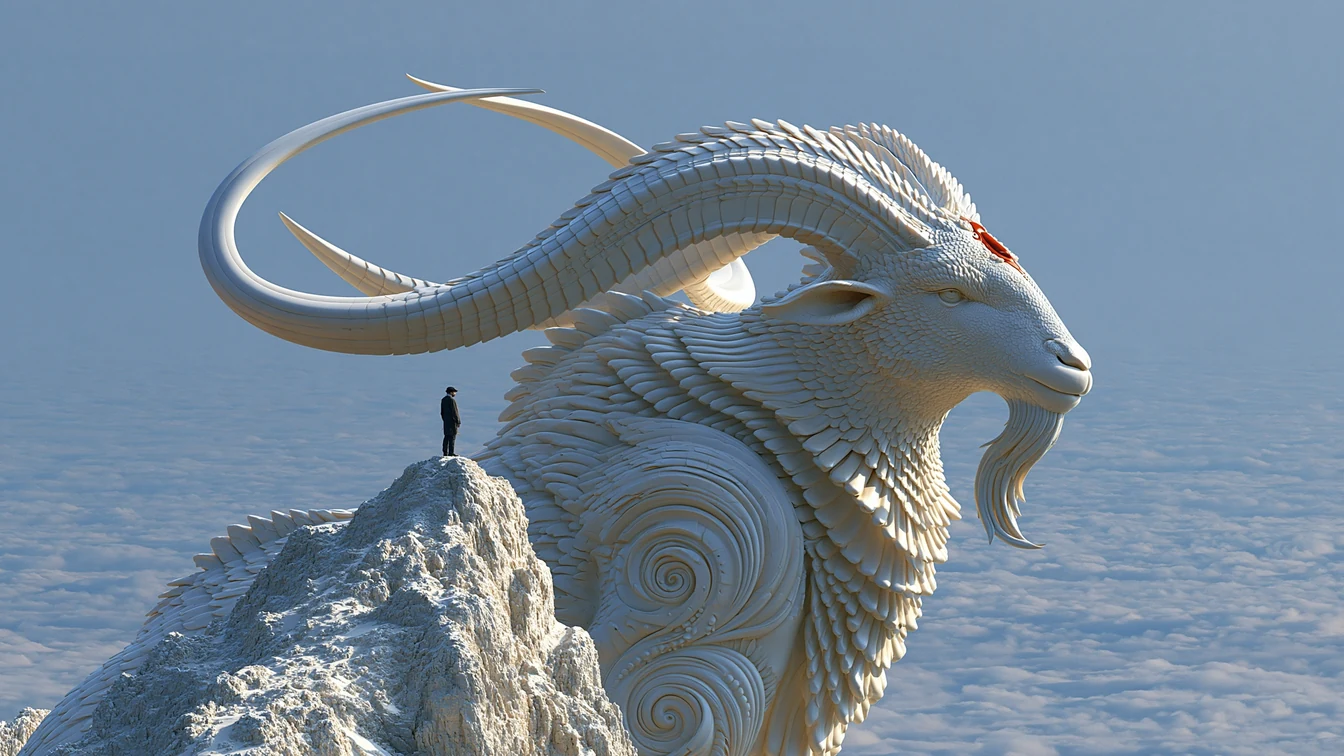
No. 08 · Chinese zodiac Goat · 羊 · Wèi
The Goat on the High Crag
Chinese zodiac Goat (羊) — the most underrated sign of the twelve. The tradition has never once described the Goat as weak, only as something that refuses to fight.
未时 falls between one and three in the afternoon, when the heat has softened and the light goes flat and the day, having already done whatever it was going to do, becomes mild. It is the hour of the high pasture: goats climb in the cool of the afternoon, and the eighth hour of the Chinese day belongs to the animal that spends its life on ground nobody else can stand on.
The Specimen
- Earthly branch
- 未 Wèi
- Hours
- 13:00 – 15:00
- Element
- Yin Earth
- Direction
- South-southwest
- Season
- Late summer
- Zodiac position
- Eighth of twelve
Section 01The Eighth Hour
未时 is the first hour of the afternoon decline. The sun is past its peak, the shadows have begun to lengthen, and the urgency of the morning has evaporated. In the agricultural calendar it was an hour of secondary work — mending, sorting, walking the herd back down.
未 is the eighth earthly branch and the last month of summer. It sits at the hinge where summer stops being summer and begins to become autumn, which makes the Goat — the most gentle and most easily overlooked sign — the guardian of a turning point. The tradition likes this kind of irony.
Section 02Yin Earth
The Goat carries yin earth, the same element as the Ox and the Dragon, in its most yielding form. Where the Dragon is the mountain and the Ox is the field, the Goat is the thin soil on a rock face — earth that has very little to work with and grows something anyway.
Goat people are described as gentle, artistic, empathetic and quietly stubborn. They are the sign most associated with creative work: not the aggressive creativity of the Dragon or the theatrical creativity of the Monkey, but the slow, patient, private making of things. A Goat will spend four years on a project nobody has asked about, and will not mention it.
The tradition’s criticisms of the Goat are real and consistent. Goats are indecisive — not from weakness of will but from a genuine capacity to see merit in every option. They are prone to pessimism and to a low-grade melancholy that other signs find hard to sit with. And they depend on other people more than they like to admit, which makes them easy to manipulate and slow to leave a situation that is bad for them.
Section 03Eighth, on a Raft
The Goat’s race story is the most collaborative of the twelve. The Goat, the Monkey and the Rooster crossed the river together on a raft — the Monkey found the materials and did the building, the Rooster kept watch and called out the current, and the Goat, in the versions that mention it, did the thing the other two could not: it stayed calm.
They arrived eighth, ninth and tenth, in that order. Three animals with completely different temperaments, who would not naturally have chosen each other, cooperating on a crossing and finishing in a cluster in the middle of the field.
It is the least dramatic passage in the whole cycle and possibly the most instructive. Nobody tricked anybody. Nobody lost a place to a passenger. Three animals pooled what they had and got across. In a set of stories otherwise dominated by cleverness and force, the Goat’s placement is the tradition’s quiet case for the third method.
Three animals who would never have chosen each other built a raft, got across, and finished eighth, ninth and tenth. Nobody tricked anybody.
The Twelve · I Ching
Section 04The Goat in the World
The character 羊 is one of the oldest auspicious symbols in Chinese writing. It appears in the oracle bones, and it is the pictograph of a ram’s head. It is also, by a piece of wordplay that the tradition has enjoyed for three thousand years, closely related to 祥 — auspiciousness, good fortune. 吉祥如意, the standard New Year blessing, contains that same element. To say “goat” in classical Chinese was, quietly, to say “good luck”.
This makes the Goat one of the most paradoxically regarded signs in the cycle. In the popular shorthand of Chinese astrology the Goat is often described as unlucky — a sign of hard work without proportionate reward, of a life that is comfortable rather than brilliant. And yet the animal itself is carved into the oldest lucky characters in the language. The two readings have coexisted for millennia, and the tension between them is probably the most honest thing the tradition says about gentle people.
The Goat is also the middle sign of the zodiac’s fourth triangle — Goat, Rabbit, Pig — three signs that all prefer harmony, all dislike confrontation, and all, according to the tables, get along unusually well.
Section 05Reading the Goat
The compatibility tables pair the Goat most happily with the Rabbit and the Pig, and with the Horse, whose forward motion gives a Goat something to be pulled along by. The difficult pairing is the Ox, whose blunt reliability reads to a Goat as a refusal to understand.
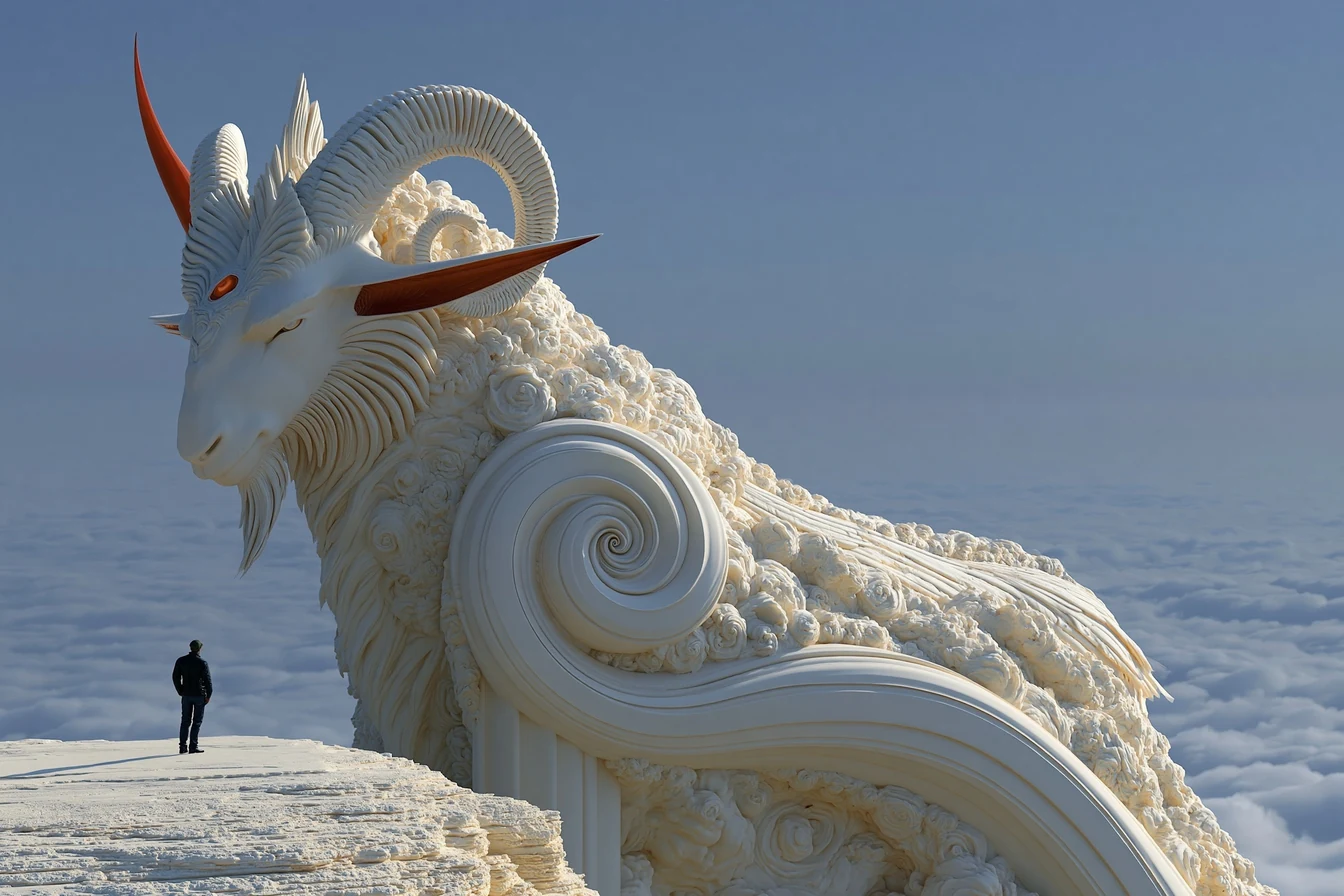
The tradition’s advice to the Goat is not to become harder. It is to notice that the crag it is standing on is genuinely higher than the field the Ox is ploughing — and that nobody is going to say so. A Goat that waits for recognition will wait a long time. A Goat that keeps making things anyway is, in the oldest reading of its own character, already lucky.
Section 06The Sixty-Year Round
The twelve animals cycle against ten heavenly stems, and the stems run in pairs through the five elements. That is why the full cycle is sixty years and why every animal has five forms. The Goat’s five:
Metal Goat (1931, 1991) — the most disciplined and the most resilient; a Goat with an unusual capacity for finishing things. Water Goat (1943, 2003) — the most empathetic and the most intuitive; the one most likely to be an artist and most likely to be hurt. Wood Goat (1955, 2015) — the most creative and the most idealistic; generous, imaginative, and slow to commit. Fire Goat (1967, 2027) — the most expressive of the five, and the one whose gentleness has the most heat behind it. Earth Goat (1979, 2039) — the most grounded and the most reliable; the Goat that everyone underestimates and everyone depends on.
For a sign defined by receptivity, the element is the difference between a Goat that makes things quietly for thirty years and a Goat that eventually shows them to somebody.
Section 07The Year of the Goat
A Goat year returns every twelve years and the tradition reads it as a gentler year — good for the arts, for family matters, for healing and for anything that benefits from being done slowly. It is not considered a strong year for confrontation or for large speculative moves.
本命年, for a Goat, is the return of its own sign at twelve, twenty-four, thirty-six. The year god 太岁 is understood to be directly overhead; the conventional protection is red worn from before the new year, given by an elder.
The custom is unusually well suited to the Goat, which is the sign most likely to be quietly unhappy and least likely to mention it. A red belt handed over by a grandparent is a small, concrete piece of evidence that somebody is thinking about you — which is exactly the kind of reassurance the Goat will never ask for.
The advice the tradition gives a Goat in its own year is the same advice it gives always, and it is not a correction. The crag is genuinely higher than the field the Ox is ploughing, and nobody is going to say so. A Goat that waits for recognition will wait a long time. A Goat that keeps making things anyway is, in the oldest reading of its own character, already lucky.