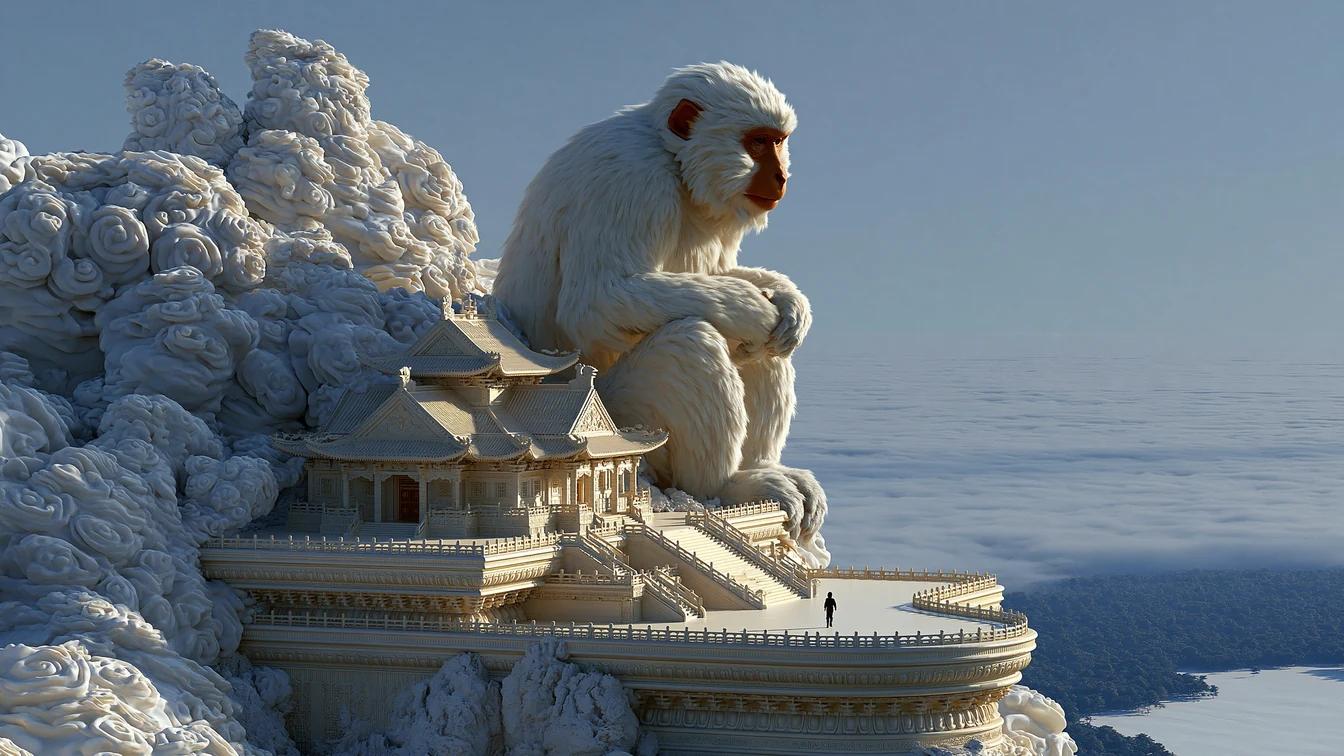
No. 09 · Chinese zodiac Monkey · 猴 · Shēn
The Monkey and the Mountain
Chinese zodiac Monkey (猴) — China's most beloved literary character is a monkey, and for five hundred years he has been the only figure in the zodiac who ever successfully argued with heaven.
申时 runs from three to five in the afternoon, when the light has gone gold and the shadows are long and the day has acquired a momentum of its own. Monkeys in the wild are loudest in this hour — calling across the canopy as the temperature drops. The ninth hour belongs to the animal the Chinese tradition treats less as a beast than as a person with a particularly difficult personality.
The Specimen
- Earthly branch
- 申 Shēn
- Hours
- 15:00 – 17:00
- Element
- Yang Metal
- Direction
- West-southwest
- Season
- Early autumn
- Zodiac position
- Ninth of twelve
Section 01The Ninth Hour
申时 is the first hour of the autumn months in the classical scheme: 申 is the ninth earthly branch and opens the season of metal, harvest, and sharpening. It is also, in the daily cycle, the hour when the afternoon starts to feel like it has been going on a while. Work gets finished or abandoned. Appetite returns. The light turns.
The Monkey’s placement here matches its reputation for a particular kind of late-afternoon energy: inventive, sociable, slightly mischievous, capable of producing something brilliant precisely when everyone else has stopped trying. It is not the hour of discipline. It is the hour of the improvised solution that turns out to be better than the plan.
Section 02Yang Metal
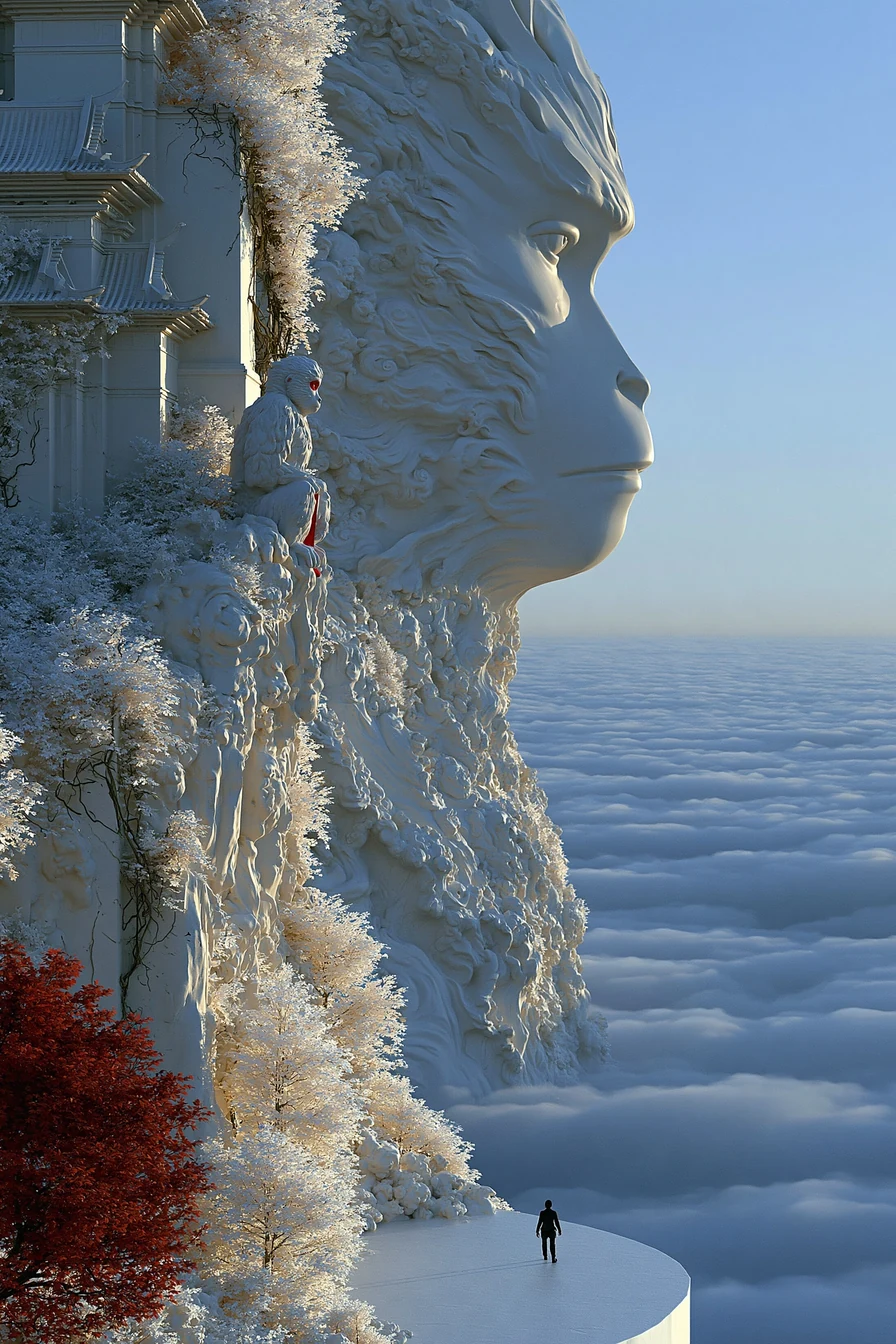
The Monkey carries yang metal — the element of the blade, the coin, the instrument. Metal in Chinese cosmology is the autumn phase: contraction, refinement, the separation of the essential from the dross. Yang metal is that force applied outward — decisive, sharp, and inclined to cut.
Monkey people are described as clever, curious and unusually quick to learn. They are the sign most likely to be good at something they have never been taught, and the most likely to be bored by anything they have already mastered. Their problem-solving is genuinely inventive; the Monkey is the animal that gets the lid off the jar while everyone else is looking for the opener.
The tradition is unusually direct about the drawbacks. Monkeys are mischievous, and mischief is not always benign. They are prone to arrogance — particularly the specific arrogance of someone who is used to being the quickest person in the room. And they can be unreliable in a way that is not malicious but is nonetheless damaging: a Monkey who has lost interest will simply not do the thing, and will be genuinely puzzled that anyone minded.
Section 03Ninth, on the Raft
The Monkey’s race story is the most practical of the twelve. Arriving at the river with the Goat and the Rooster, the Monkey did not attempt to swim, find stepping stones, or attach itself to a larger animal. It looked at the problem, found materials, and built a raft.
The three crossed together and finished eighth, ninth and tenth. The Monkey placed ninth — behind the Goat, which is a nice touch, because the Monkey did by far the most visible work. The tradition is quietly making the point that the one who builds the boat is not automatically the one who gets off it first, and that the Monkey, characteristically, did not make an issue of it.
He did not accept the position he had been assigned in the celestial hierarchy. He objected — and heaven could not subdue him.
The Twelve · I Ching
Section 04The Monkey King
No other zodiac animal has anything like the literary career of the Monkey. 孙悟空 — Sun Wukong, the Monkey King — is the protagonist of Journey to the West, one of the four great classical novels of Chinese literature, and arguably the most recognisable character in Chinese culture after the dragon itself.
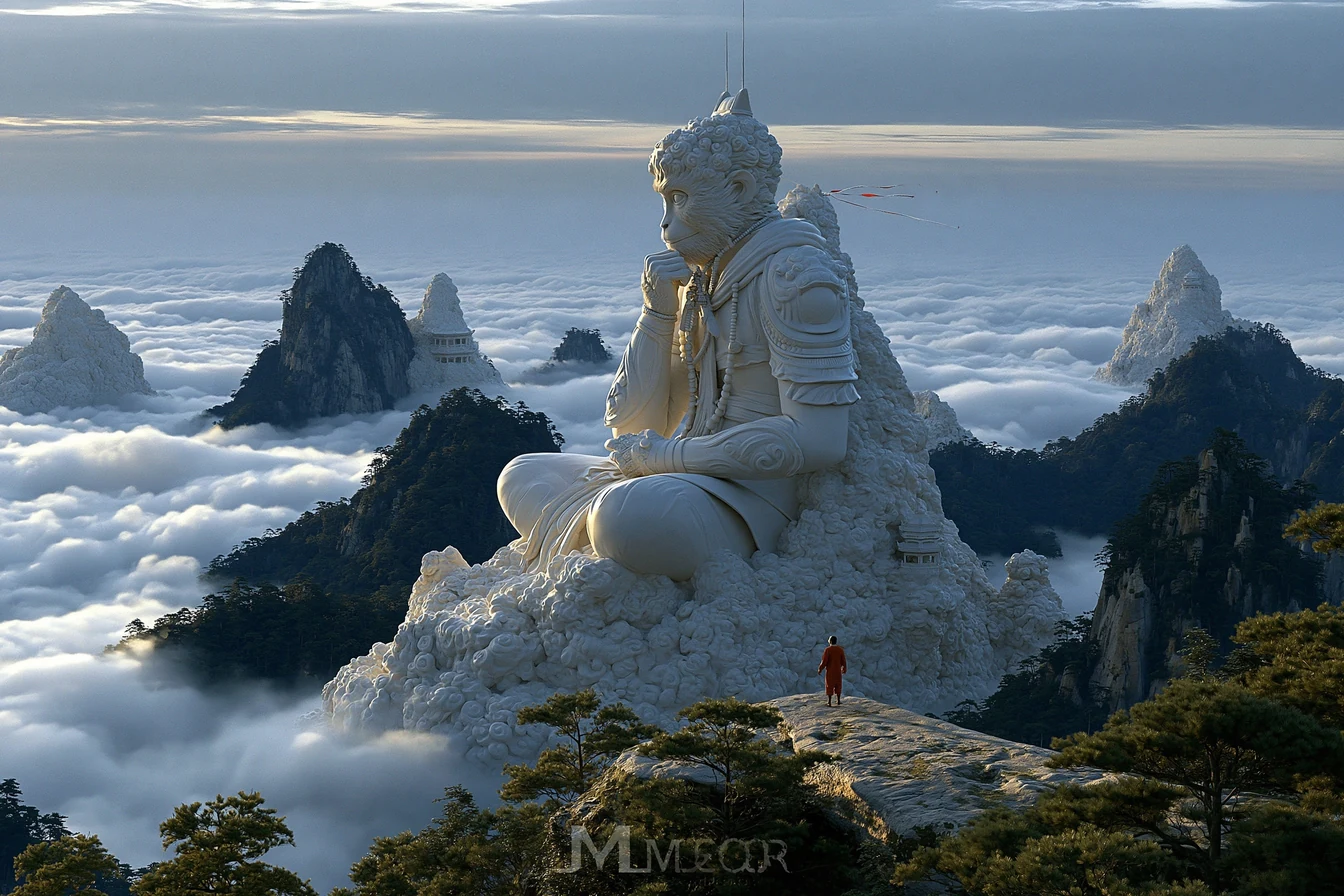
His story is worth summarising, because it is a story about a Monkey in the exact sense the zodiac means. Born from a stone egg on a mountain, he teaches himself magic, acquires a weapon (a staff that once held up the sea), and then — this is the crucial part — he does not accept the position he has been assigned in the celestial hierarchy. He objects. He objects so effectively that the armies of heaven cannot subdue him, and he ends up bargaining with the Buddha himself. He is finally imprisoned under a mountain for five hundred years, and then released to serve as the protector of a monk travelling to India.
The character is not presented as a villain. He is presented as brilliant, insufferable, loyal, impatient, and fundamentally ungovernable — which is precisely the zodiac’s Monkey. The novel’s achievement is that it takes the sign’s most annoying quality, the refusal to accept an assigned place, and makes it the engine of the entire story.
The Monkey is also the third member of the zodiac’s first triangle — Rat, Dragon, Monkey — three signs the tradition groups as strategists. It is a strange trio on the surface: a rodent, an emperor and a trickster. But all three win by understanding a system better than the system understands itself.
Section 05Reading the Monkey
The compatibility tables pair the Monkey with the Rat and the Dragon, and with the Snake. The difficult pairing is the Tiger, who has no patience whatsoever for being outwitted — and who, unlike the Monkey, does not consider losing a game to be an acceptable outcome.
The tradition’s advice to the Monkey is the hardest counsel in the whole cycle, because it asks the Monkey to give up its greatest pleasure. Finish the thing after it stops being interesting. The Monkey King was only freed when he agreed to serve someone else’s journey to the end. It is a long book, and that is the point.

Section 06The Sixty-Year Round
Twelve animals run against ten heavenly stems, and the stems cycle in pairs through the five elements. The true round is therefore sixty years, and each animal appears in it five times. The Monkey’s five forms:
Water Monkey (1932, 1992) — the most intuitive and the most adaptable; clever in a way that is hard to argue with. Wood Monkey (1944, 2004) — the most inventive and the most generous; the one most likely to teach. Fire Monkey (1956, 2016) — the most theatrical and the most impatient; enormously entertaining and impossible to manage. Earth Monkey (1968, 2028) — the most practical of the five, and the one most likely to turn cleverness into an actual living. Metal Monkey (1980, 2040) — the sharpest and the most strategic; the Monkey that wins arguments and, occasionally, things that matter more.
The Monkey is the sign whose element most changes whether the cleverness gets used or merely displayed. An Earth Monkey builds something. A Fire Monkey performs. Both are being exactly what they are.
Section 07The Year of the Monkey
A Monkey year returns every twelve years. The tradition reads it as a year of invention and unpredictability — good for innovation, poor for routine, and generally marked by things not going according to plan in ways that turn out to be interesting.
本命年, for a Monkey, is the return of its own sign at twelve, twenty-four, thirty-six. The year god 太岁 passes directly overhead, and the standard protection is red worn from before the new year, given by an elder rather than bought.
For the Monkey, this custom is a small annual test of the one thing the sign finds hardest: accepting a boundary. The Monkey’s defining move — the one that makes it the Monkey — is to refuse the position it has been assigned. A red belt is a position assigned. Somebody older than you has decided you need looking after, and you are expected to say thank you and wear it.
The advice the tradition gives a Monkey in its own year is the hardest counsel in the cycle, because it asks the Monkey to give up its greatest pleasure. Finish the thing after it stops being interesting. The Monkey King was freed only when he agreed to serve someone else’s journey to the end. It is a very long book. That is the point.